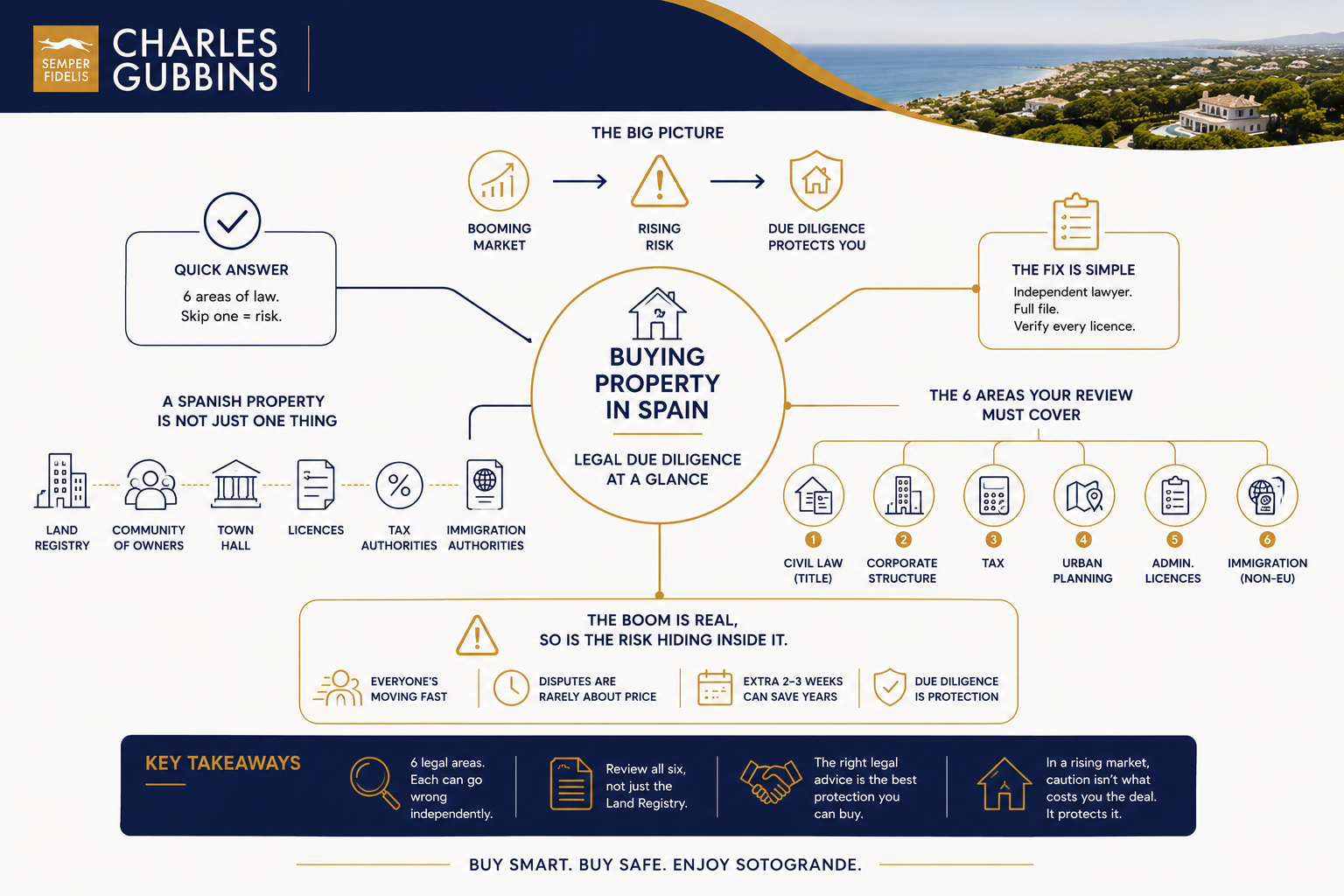
Quick answer: A Spanish residential property purchase carries risk in six separate areas of law: civil (title), corporate structure (where the property is held through a company), tax, urban planning, administrative licensing, and, for non-EU buyers, immigration. Skipping any one of these is the single biggest reason foreign buyers end up in disputes after completion. The fix isn’t complicated: instruct an independent lawyer, get the full legal file before you sign anything, and verify every licence directly with the issuing authority rather than trusting the seller’s paperwork.
I spend most of my working days on the Sotogrande property market, matching buyers with the right home. I’m not a lawyer, and this isn’t legal advice, but after years of sitting across the table from buyers at every stage of a purchase, I’ve seen which legal gaps actually cause problems, and which ones buyers worry about for nothing. This is the version of that conversation I wish every buyer had before they made an offer.
The boom is real. So is the risk hiding inside it
Spanish residential real estate is having a strong run. Sotogrande prices reached an average of around €3,712 per m² in early 2026, up 10.8% year on year, the highest level ever recorded in the area, while neighbouring La Línea (Gibraltar border) has seen even sharper growth off a lower base. Demand along the Costa del Sol has followed the same trajectory: more new-build activity, rising prices, and more international buyers than at any point since before the financial crisis.
None of that changes what a Spanish property actually is, legally. And that’s the part the headlines skip.
A rising market is, counter-intuitively, the market where the least due diligence gets done, because everyone’s moving fast, and caution starts to feel like the thing costing you the deal. In practice, it’s the opposite. The purchases that end up in dispute are rarely the ones where the buyer took an extra two or three weeks to get the file properly checked.
Why a “simple” Spanish purchase isn’t simple
If you’re buying in the UK, US, or most of northern Europe, you’re used to a linear process: find the property, have a lawyer check the title, sign, done. Spain doesn’t work that way, and the gap between the two systems is exactly where foreign buyers can get caught out.
A Spanish property isn’t a single legal object; it’s several overlapping legal positions, each sitting in a different registry, checked by a different authority, and capable of going wrong independently of the others. The Land Registry can show a completely clean title while the local Town Hall is holding an open planning-infraction file on the same building. A rental licence can exist on paper and be worthless in practice, because the community of owners voted against short-term lets last year. A company can hold clean title to an asset while carrying tax debts that transfer with the shares.
None of this is exotic. It’s routine. The problem is structural: a review that checks only the registry will pass a property that a review of all six legal areas would have flagged.
The six areas your legal review has to cover
If a due diligence review doesn’t touch all six of these, it’s a title check wearing a due-diligence label.
- Civil law — title and what comes attached to it. This covers the Land Registry entry, the nota simple, any mortgages, embargoes, easements, rights of way, and usufructs, plus whether every co-owner or heir with a legal interest has actually signed off. Encumbrances follow the property, not the person selling it; if there’s a charge registered against the asset, you inherit that charge the moment you complete.
- Corporate structure — how the property is held. Some residential properties, particularly larger villas and luxury homes, are held inside a Spanish company (an SL) rather than owned directly by an individual. Buying the shares in that company is a completely different transaction from buying the house; you inherit the company’s entire history: its debts, its tax position, any past liabilities, its old contracts. A direct purchase and a share purchase can look almost identical in conversation and are entirely different legal animals. That choice needs to be made during the legal review, not negotiated as an afterthought.
- Tax — decided before you sign, not after. What you pay in Spain depends on what you’re buying, how you’re buying it, who’s buying it, and where that buyer is resident for tax purposes. The structure is locked in at the point of signature. Everything after that is optimisation within a box someone else already built, usually the seller, or the seller’s notary. If you want the tax structure to work in your favour, that conversation happens before completion.
- Urban planning — what the building legally is, not just what it looks like. Is the land classified for what’s actually built on it? Is the construction declared? Is there an open disciplinary file at the Town Hall? A property can be beautifully finished, fully insured, even mortgaged by a bank, and still be, in planning terms, an infraction waiting to be discovered. The Land Registry won’t tell you this. Only the Town Hall will.
- Administrative law — licences and permits that are actually in force. Occupancy licence, first-occupation certificate, and tourist rental registration if you plan to let the property, all of these are conditional and revocable, and it’s common for a current owner to have quietly stopped meeting the conditions attached to one. A licence sitting in a file is not the same thing as a licence in force. Always verify directly with the issuing body.
- Immigration law — separate from the purchase itself. For non-EU buyers especially, “I bought a property in Spain” and “I have the right to live in Spain” are two unrelated legal questions that get conflated constantly. Ownership gives you an asset. It doesn’t give you residency. Your residency route, and your tax residency, which is its own separate question, changes how the purchase should be structured and how any rental income gets taxed.
The problems I actually see buyers walk into
These aren’t hypothetical. Versions of every one of these show up regularly in transactions across the Costa del Sol and Sotogrande:
- Debts attached to the property, not the seller. Mortgages, embargoes, and certain charges follow the asset. They don’t disappear at completion; they change owner.
- Unlicensed building work. Extensions, pools, extra floors, or terraces built without a licence, sometimes on land whose classification never permitted them in the first place. Legalisation is sometimes possible, sometimes expensive, sometimes off the table entirely, and which of the three applies is knowable before you buy, not after.
- Licences that look valid and aren’t. No first-occupation certificate, or a tourist rental licence that was never properly granted. If you’re buying partly for rental income, this is the difference between buying a working investment and buying a house that simply can’t be let the way you were told.
- Unpaid municipal taxes and capital-gains liability sitting quietly behind a sale that otherwise looks straightforward.
- Community of owners arrears or a looming special levy for a roof, lift, or facade repair, attached to the unit, not the previous owner, and rarely mentioned until after completion.
- Short-term rental restrictions. An investment case built entirely on holiday-rental income that the community, the town, or the region simply doesn’t permit. Spain’s short-term rental rules have shifted multiple times recently, including a 2026 Supreme Court ruling striking down the national unified rental registry; regional rules now govern, and they vary. Verify the licence route that actually applies to your specific property before you build a rental income projection around it.
- Mortgage clauses that were never fair to begin with. Floor clauses, IRPH indexing, and imposed insurance premiums baked into mortgage deeds signed without independent advice.
- Registry mismatches. The property described in the deed, the one in the Land Registry, the one in the Cadastre, and the one you actually walked through are supposed to describe the same thing. Often they don’t, and the gap becomes the boundary dispute you inherit.
Due diligence cost vs. litigation cost — there’s no real comparison
A proper pre-purchase legal review has a defined scope, a defined timeline, and a fee you agree before you commit to it.
Litigation has none of those boundaries. It runs for years rather than weeks. Its cost depends on how the other side chooses to fight, not on your budget. And critically, it’s fought entirely over a document you’ve already signed, which means your strongest arguments were fixed in place by the quality of the review you did (or skipped) before you got there.
Due diligence is the cheapest point in any transaction at which a serious problem can still be caught, because it’s the last point at which you can still walk away without a loss.
What to check before you sign anything
Not after the reservation contract. Not after the deposit lands. Before.
- Use an independent lawyer — not one recommended by, related to, or paid by the seller, the developer, or the selling agent. If the same person is advising both sides, you don’t have independent advice.
- Treat a reservation contract as a real contract. A reservation and a deposit both create binding legal positions, and both are routinely signed before anyone has reviewed the property’s legal file.
- Request the complete legal file: nota simple, title deed, cadastral certificate, planning certificate from the Town Hall, all relevant licences, community statutes and recent meeting minutes, the energy certificate, and, if a company is involved, its accounts and tax history.
- Settle the tax structure before signature. It can’t be changed afterwards without cost.
- Verify every licence with the issuing authority directly, not from a copy in the vendor’s file.
- Pressure-test any rental income assumption against the actual regional and community rules that apply to that specific property.
- Treat the residency question and the property question as two separate decisions, and get both answered properly.
Frequently asked questions
What does legal due diligence actually cover when buying in Spain? Six areas: civil law (title and encumbrances), corporate structure (if the property is held through a company), tax, urban planning, administrative licensing, and, for non-EU buyers, immigration. A review that only checks the title isn’t due diligence.
Can I inherit debts I didn’t know about when I buy a Spanish property? Yes. Mortgages, embargoes, and certain other charges attach to the property itself rather than to the person selling it. Community fee arrears and unpaid municipal taxes can carry over similarly. That’s why the registry, cadastral, and community position all need checking before you sign.
Is buying the company that owns a property different from buying the property itself? Very different. Buying shares means inheriting that company’s entire history: debts, tax exposure, employment obligations, old contracts, not just the physical asset. The two structures can look similar in a negotiation and are entirely different in law.
Does the seller’s lawyer or the estate agent’s recommended lawyer count as independent? No. Independent means not recommended by, related to, or paid by the seller, the developer, or the agent. If one adviser is effectively on both sides of the deal, you don’t have independent protection.
Can the tax structure be adjusted after completion if I get it wrong? No. It’s fixed at the point of signature by what you bought, how you bought it, and your residency status. After that, you’re working within a structure that can’t be changed without additional cost.
Does owning property in Spain give me the right to live there? No. Ownership is an asset question. Residency is a completely separate legal question, and it affects how the purchase should be structured and how any rental income is taxed.
When should the legal review actually happen? Before signing a reservation contract and before transferring any deposit. Both create binding legal positions. Due diligence only protects you if it happens before you’re committed — not after.
I work with buyers across Sotogrande and the wider Costa del Sol, and I always recommend an independent Spanish property lawyer before any offer becomes binding. The legal side of a purchase isn’t something an estate agent should be doing for you, and it isn’t something to shortcut. If you’re actively looking in the area and want an honest read on a property before you go further, I’m happy to talk it through.
Charles Gubbins